Being an expansion of the project Dada Manifesto from 2015, this solo exhibition at Art Museum Trøndelag March 2020, was a collaboration with dance students from the local high school, Olav Duun Videregående skole, where new manifestos were produced, played and performed, with movement.
The exhibition also included an art workshop for kids creating their own music box work, displaying it alongside the original dada manifestoes, on music box scrolls, from early 19-hundreds.
The exhibition was part of Trøndelag Electronic Art Center, TEKS, biennal Meta.Morf X-Digital Wild 2020.
Dada Manifesto by Hugo Ball (1916) Vertically. (2016)
Music box, sheet music, confetti, box.
Produced in collaboration with Arild Tveito and Santolarosa (2020).
The work, in it’s boxed form, was first shown at Artissima in Turin, Italy, November 2019.
Dada Manifesto (2016) is, in its entirety, a music box work of a total of 8 dada manifestos from the period 1916 to 1921 by Hugo Ball, Tristan Tzara, Francis Picabia, Raoul Hausmann and others. The texts are copied to long strips of paper and all the D’s and A’s in the text are removed with a punching machine. When you play through the strip of paper, it is the absence of D-A- D-A in the manifestos you hear.
Manifestation is about making something clear or obvious; shaping a manifesto is about making visible and making public something that is important to one.
Dada was the first conceptual art movement where artists did not create aesthetically pleasing objects. The manifestos, which originated in the Dada movement, challenged bourgeois conventions and asked, and generated, challenging questions about society, about the role of the artist and about the meaning of art.
Dada Manifesto has previously been shown and performed at Sound Of A Cage, Tou Scene (Stavanger), Malmö Konsthall (Malmö, Sweden) and represented by the Oslo-based publisher Santolarosa during the art fair Artissima 2019 (Turin, Italy). Published on Twitter, in para · text # 2 (London, UK) and in COLDFRONT Magazine (New York / www).
https://santolarosa.no/
My work and thoughts on geopoetics were published by Routledge December 2019 alongside other essays examining the dynamic intersection of poetry and geography.
Grounding itself in the question, What would an encoding of nature and geography sound like?, this chapter presents four art projects that share a geopoetic mindset. It thematizes the human need for systematization and questions if there is a direct and common sensory connection between language and the world—between topography, typography, text, architecture, and sound. Where reading practices of geography generate musical and/or visual scores, the result is a verbalization of geography.
Get your copy here.
Derek Beaulieu’s a, A Novel erases all the text in Andy Warhol’s 1968 novel, leaving only the punctuation marks, typists’ insertions and onomatopoeic words.
I was invited to response to Beaulieu’s book, published for Jean Boîte Editions (Paris) August 2017.
My response turned into two sound pieces: "p343 dick isn’t that big", and "p343 for Theodor W. Adorno".
The original novel by Andy Warhol is a transcription of everything Ondine (Robert Olivo), one of Warhol’s assistant at The Factory, says during a couple of days in 1968.
Randomly picking a page of the book, page 343, sleeve titled in the original book by Warhol as dick isn’t that big, I chose to use two different methods of composing. The sound in "p343 dick isn’t that big" is solely hand-drawn punctuation marks, from page 343, on the soundtrack of 16mm film.
"p343 for Theodor W. Adorno" is composed with help from Theodor W. Adorno’s essay punctuation marks, where he claims punctuation marks to be “marks of oral delivery.” Because of that, they’re a sort of musical notation: “The comma and the period correspond to the half-cadence and the authentic cadence.” Exclamation points are “like silent cymbal clashes, question marks like musical upbeats.” Colons are like “dominant seventh chords.” This piece is a collaboration with singer Stine Janvin Joh.
The two pieces are included in the collection (drowned out by traffic noise): a, A Novel, created in collaboration with Alan Dunn/cantaudio (Leeds, UK), which composes ten audio responses to the book into this single 60-minute soundtrack.
Other contributors are:
Pascalle Burton - After the After Party, 1979 radio
Peter Jaeger - a A Novel p85
Karri Kokko - Haukotus (Yawn) A
Sylvain Chauveau - a, page 113
Gary Barwin - Typing Warhol Page 1
Prof. Oddfellow - Clockwork Punctuation
Gary Barwin & Arnold McBay - texture: code: sound
Alan Dunn & collaborators - p100/101 featuring Molly Wookey, an elderly lady on whom Dr. Arthur Spencer at Powick Psychiatric Hospital trialed heavy doses of LSD + Weirdomusic Drip, Drip, Drip + The Ramonas Let’s Dance + WOMPS recording with Steve Albini in Chicago, captured by Katie Strang + AD&THEFILMTAXI X + Jean-Philippe Renoult Nosey Noises, a medley of George Clinton’s nostril noise and breathing + Jeff Young Chapter III (ocean) and Chapter IV (ritual) + Noisesurfer Silence and Water.
Artwork by Arnold McBay, design by 67projects, Peter Jaeger track mastered by Ken Brake at Regal Lane Studio, London.
In between a maple syrup harvesting field and the outbuildings of a closed agricultural college in the small town of Kemptville, Ontario in Canada, there's an abandoned field of planted black walnut trees in rows. In this black walnut grove 10 new blank scores (1.-10.movement) will be installed every new season.
More about the rout/e grove poems project here.
The manifesto, the text, on one or several A4-pages, is cut into one long strip to fit a music box and then spliced with tape. Some manifestos has been scanned from top to bottom (vertically) and others from left to right (horizontally). The letters D and A in the text are then punctuated, so the absence of D and A (..DADA), is what you hear being played.
The first dada manifesto by Hugo Ball (1916) encourages poets to stop writing with words, but rather write the word itself, and Ball states that:
"I shall be reading poems that are meant to dispense with conventional language, no less, and to have done with it"
In this way this collection of Dada Manifestos acts in accordance with Ball's manifesto, using the word construct as the direct source.
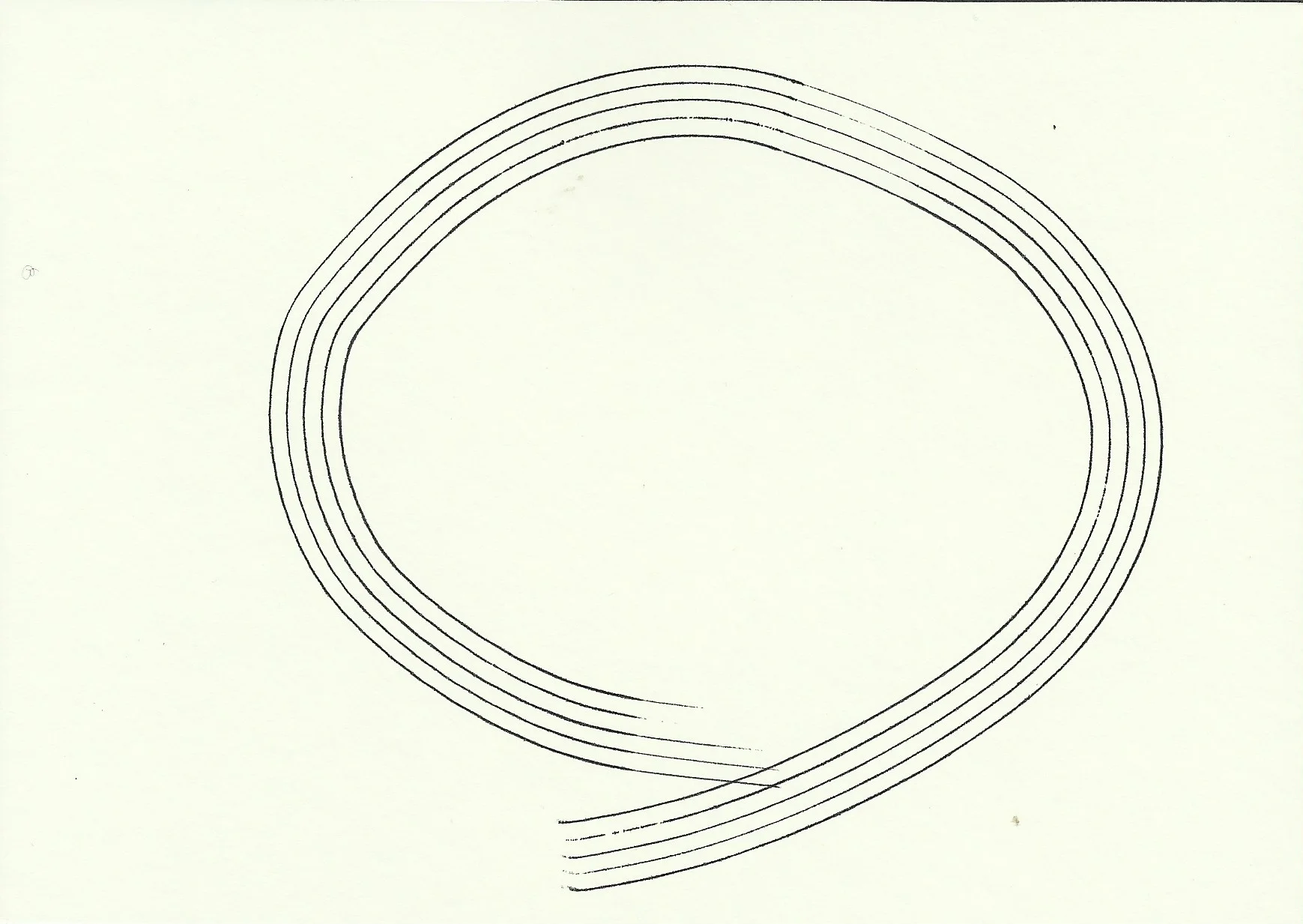
Staff lines in a circle, hand drawn with a rolling ink stamp, in one uninhibited stroke; the ensō is a practice related to zen and the idea of wabi-sabi; often explained as the beauty of imperfection.
Combined with the idea of the sustained or repeated tone in minimalistic drone-based music, often characterised by lengthy audio performances, the ensō, on the other hand, is a documentation of the creator’s state of mind and the context of creation in a brief period of time.
30 drawings, one drawing done every day of January 2018, was printed and published by Timglaset (Malmö, Sweden) April 2018.
For sale here, but also at Malmö Konsthall (Malmö, Sweden), Butikken (Copenhagen, Denmark) and Bookartbookshop (London, UK).
The project is based upon a work by Christian Marclay, where 100 sheets of blank staff paper was hung up in the town Namsos during spring 2015. Later, the notation and the scribblings of passersby was documented and performed at Kunstmuseet Nord-Trøndelag, May 7th 2015 by Eirik Øien and Martin Langlie.
The band Starship released in 1985 the song We Built This City that quickly became a hit. The lyrics describes the youthful idealism of a city built on rock'n roll, freed from the corporate world.
However, in order to construct the skyline of the city in the lyrics, the text has been deconstructed after several rounds in the translation tool Google Translate.
In his way We Built This City has built a city.
First published in Matrix Magazin's Conceptualisms Dossier (2012) and later in The New Concrete: Visual Poetry in the 21st century, Hayward Publishing (2014).
Barcodes is a film based on manipulating a barcode to play scales of tones. The barcode has been copied to a transparent sticker and then glued to the film all the way to the soundtrack of the film. The barcode then makes sound as it passes the photoelectric cell. By having glued on a barcode in different sizes, the barcode plays over a range of two octaves (from low to high C). The fun thing is that you can also see how the volume changes with the contrast of the lines. The more contrast the higher volume.
Full version out on YouTube here.
The film was shown in an installation titled "Composition for a film projector, barcode and a spotlight". The installation consists of, as the title discribes, a 16mm film projector, a spotlight and a film.
The project is based on the first paragraph in Paul Auster's novella Ghosts. The composition consists of 3 short movements. The first movement is the original text straight from the book (ill.), the two following movements are versions of the paragraph that has been trough Google Translate so many times that the text is altered into strange sentences and meanings. The composition was done by isolating the letters C, D, E, F, G, A, B in the text and using them in a notational system to indicate pitch. The absence of the characters in between the chosen letters indicate the durations/note values.
Sound cloud:
1.movement –First Of All There Is Blue
2.movement –Brown And I Got Ham
3.movement –White And Blue (This Section Includes Education)
Performed at ++, Black Box Teater (Oslo), Signal (Malmø), The Annual State Exhibition 2013 (Oslo) and Alte Schmiede (Vienna).
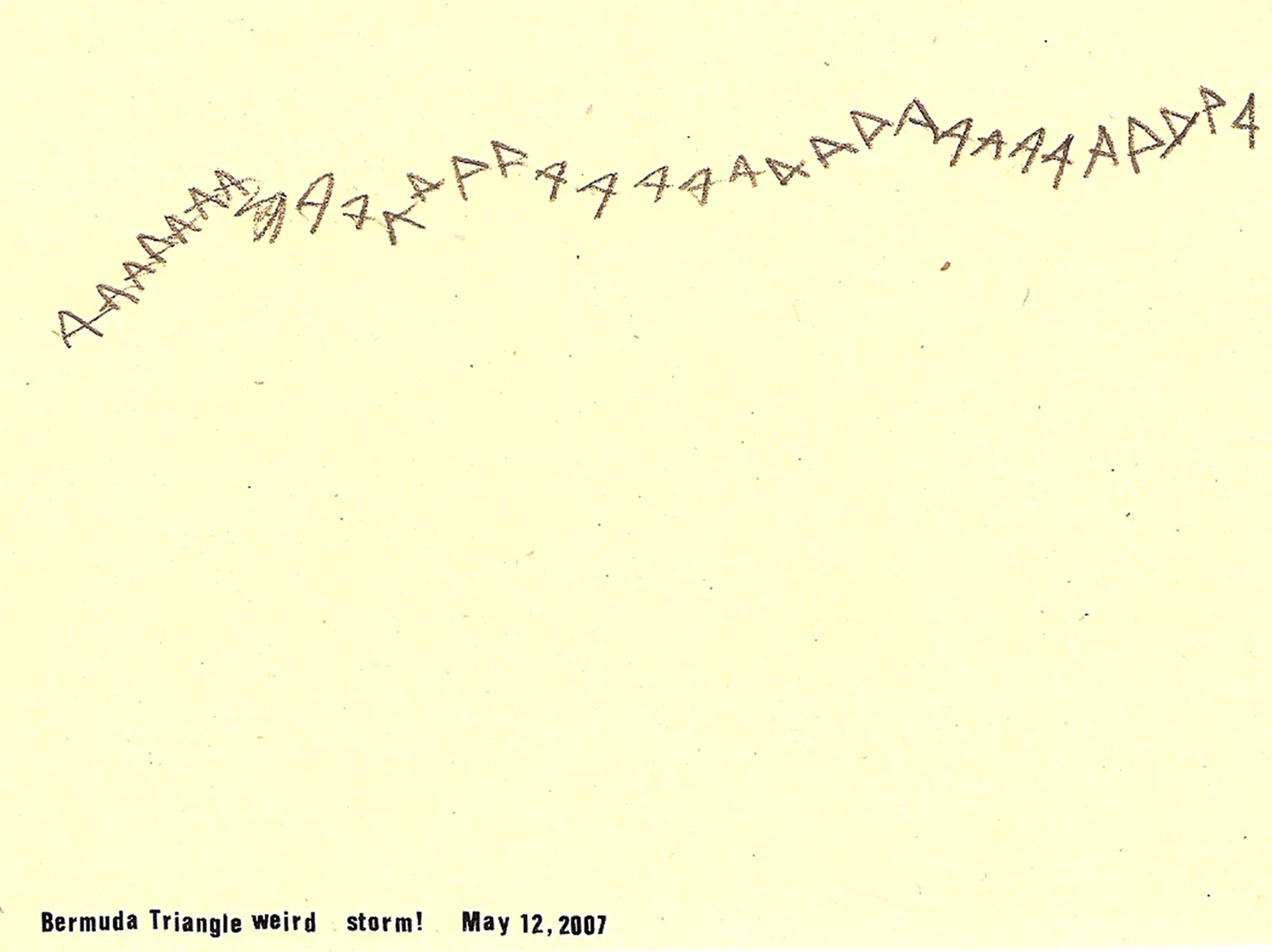
(The poetry of) Repetitive Vertical Movement (at sea).
The drawings, taken from YouTube, of a boat's repetitive vertical movement at sea, produced in the spirit of surrealist automatic writing, seeks to be a score of movement; also carrying the possibilitiy to be reproduced in sound. From the boat's bridge point of view, the horizon appears and disappears.
Published at UBUweb.
This project has been performed by students and professors from KHiO during the deefakt/Ultima festival 2011, an amateur choir at Produzentengalerie Luzern (Switzerland) 2013 and by professional singer Stine Janvin Motland at Alte Schmiede in Vienna (Austria) 2014. It has also been performed at the opening at Kunstmuseet Nord-Trøndelag, April 18th 2015 by members of three local choirs: Namsos Kammerkor, Cygnus and Salt, under direction of Elina Karpinska.
"En tenkt tanke må alltid oversettes og bearbeides før den finner sin vei ut, og en tankes originale og opprinnelige mening er alltid i fortolkningens svøpe og sårbar overfor meningsforvrengninger. Tilsløring av den originale mening starter allerede der."
Marianne Bruusgaard (www.forlagsliv.no/Cappelen Damm, 10.10.11)
(Seems like the perfect meta-challenge to translate this quote:)
"A thought must always be translated and processed before it finds its way out, and the thought's original and genuine meaning is always in the swaddle of interpretation and vulnerable to the distortion of meaning. Veiling of the original meaning starts there."
The project takes it place from the philosophy of dialogue by Martin Buber and a quote taken from a the blog post Hvordan vet vi at en oversettelse er god? (How do we know that a translation is good?)(www.forlagsliv.no/Cappelen Damm, 10.10.11) where editor Åsfrid Hegdal is quoting her friend Marianne Bruusgaard.
This quote in Bokmål is translated to 4 other languages in Norway; Nynorsk, Sami, Kvääni and Norwegian-Romani. The texts are used in the composition by isolating the notational letters (C, D, E, F, G, A, and H) and bringing them in to the notational system to indicate pitch. The absence of the characters in between the chosen letters indicate the durations/note values.
The piece is made for a quintet of aerophones; flute, clarinet, oboe, bassoon and horn.
In all of Norway Bokmål and Nynorsk are equal languages. North Sami language is equal to the Norwegian languages in some regions in Finmark and Troms. Kvääni (Kvensk) was in 2005 acknowledged as a separate language in Norway. In addition to these languages, Norwegian-Romani is in a special position as the romani people came into the country in the 16th century. Their original language, romanés -with roots from India, has been developed over the years into an oral language called Norwegian-Romani still in use in Norway today.
Quintet:
Yumi Murakami - flute
Kristine Tjøgersen -clarinet
Christine Lorentzen - oboe
Hanne Rekdal - bassoon
Daniel Weiseth Kjellesvik - horn
Shown at the Oslo Poesifilm Festival/Kunstnernes Hus, November 16th 2013.
Arranged by Oslo Poesifilm and Ny Musikk.
Supported by the City of Oslo and Språkåret 2013.
Most of the time I wonder how things would sound like if you gave them the opportunity to emit sound. Fra Vestfjorden is adressing these questions by translating the form of mountains to a composition for a string quartet, through the graphical system of the notation. The shape of the mountain is transferred directly and analogue into a notational system as a dot-to-dot drawing where the peaks and valleys are deciding pitch and the space between the note's length.
POLARSTAR follows the sound trail of legendary Norwegian sealer M/S Polarstar. The sound works are the optical soundtrack based on harbour- and sea maps. The sound is found by using the 16mm analogue film where one physically can glue on visual elements and have it read as sound. The topography at sea and the typography of the explanatory symbols of the nautical navigational charts has been scanned and made into sound. This way we are able to hear distances and places. What you see is what you hear.
As a viewer and consumer of media and of art especially, one is expecting it to have a logic of narrativity. The need to find a story, a narrative and something solid in even the most abstract work of art, and maybe in particular when fronting sound works is present at all times. Formalism and narrativty comes together in POLARSTAR trying to find out where these parameteres (of art) collides. Including the old, outdated and possibly dying media of 16mm film POLARSTAR can be looked upon as an anachronic and nostalgic way of looking at objects, but when these objects are combined with conceptual ideas a new body of knowledge is produced.
The project was supported by The Municipality of Bergen, Arts Council Norway, Norwegian Visual Artists Association, Bergen National Academy of Arts and Filmwerkplaats Worm, Rotterdam.
Inspiring intellectuals, literary and cultural figures in the West for decades, The I-Ching, also known as The Book of Changes, is an ancient Chinese divination manual mostly consisting of cryptic statements linked to 64 hexagrams as guidelines for life. Heavily influenced by this system, composer John Cage used it to introduce indeterminacy in music.
The Great Treatise is a text-to-score translation of one page of The I-Ching, leaving out the divinity and treating the text and the letters as a notational possibility.
Published in No Press, Canada and VISPO (www/NYC).